Leading companies like CarMax have implemented AutoTrace to track hundreds of thousands of mobile assets, like vehicles and car keys, reducing costs and driving new revenue.
Thank You!
We’ve successfully received your information and we’ll get in touch with you soon :)
Oops! Something went wrong while submitting the form.
Leading companies like Schnucks Markets have implemented ExpressLane wherever they have lines of people or vehicles, delighting customers with shorter wait times and faster service.
Thank You!
We’ve successfully received your information and we’ll get in touch with you soon :)
Oops! Something went wrong while submitting the form.
Download The ExpressLane Guide
Leading companies like Schnucks Markets have implemented ExpressLane wherever they have lines of people or vehicles, delighting customers with shorter wait times and faster service.
The Three Moments That Make or Break Bay Flow in Auto Service
Staging, turnover, and idle time: These three moments determine how many cars a service center moves through its bays.
August 7, 2026
Every auto service center runs on the same finite resource: bays. More cars through those bays means more revenue, and the real limit is usually how tightly a center manages three specific moments: staging, turnover, and idle time. Get those right and a service center moves more vehicles with the crew and the footprint it already has. PitCrew is built to give operators visibility into exactly those three moments.
Staging: Getting the Right Car to the Right Bay
The first moment happens before a car ever reaches a bay. Someone has to decide, in real time, where the next vehicle goes — and that decision is only as good as what they can see. Without a clear read on which bay is about to free up, cars get staged late, staged wrong, or not staged at all and customers wait through a delay that could have been avoided.
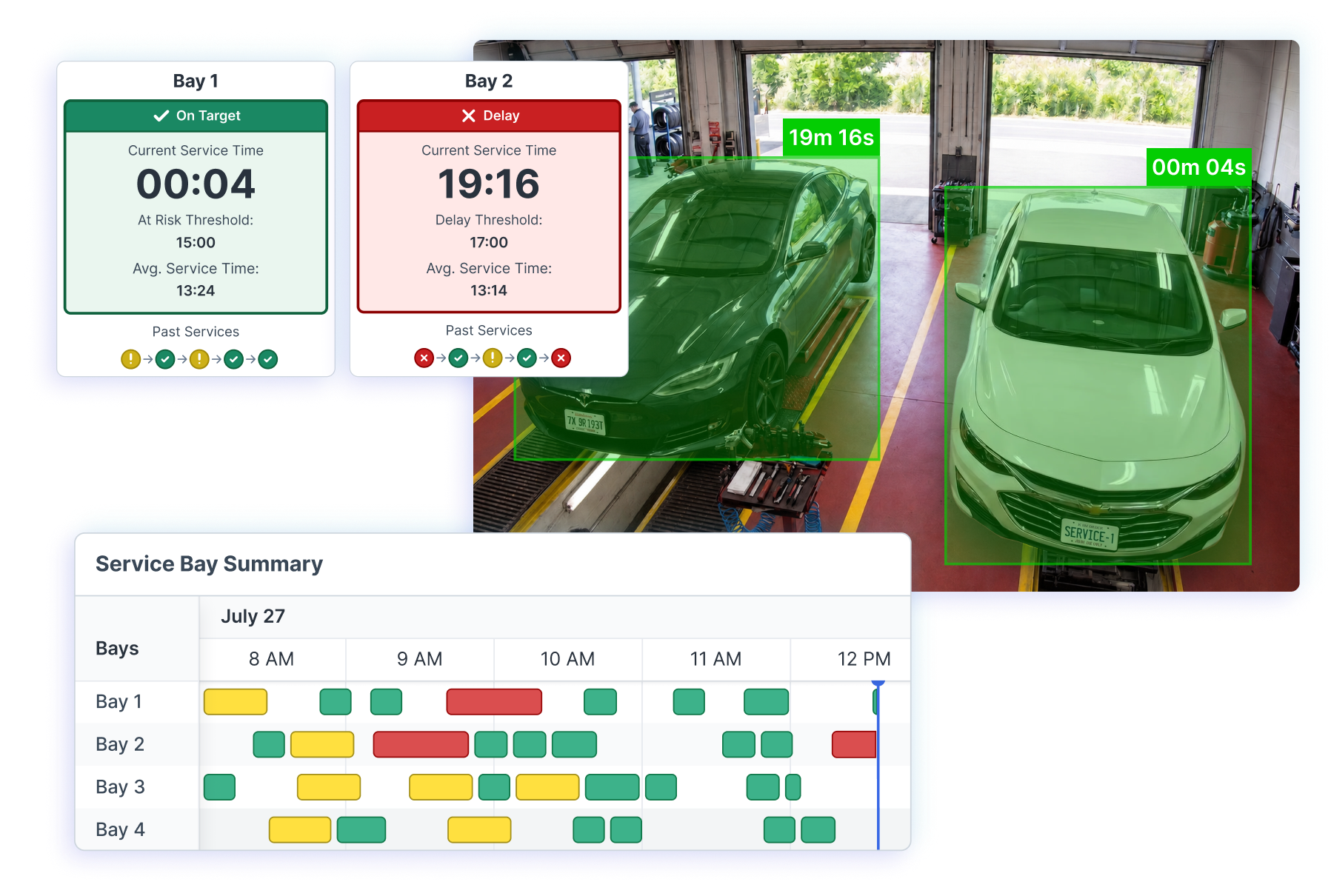
PitCrew's Live Bay Status Displays put bay information and service timers up where the whole floor can see them, so staging becomes a decision made on current information instead of a guess. As one high-volume quick-lube operator described: "When customers pull into the lot, we're using the displays to watch what bay is going to be moving first, so we're putting the customer in the right lane and moving traffic a lot faster."
The second moment is the handoff — the seconds between one car leaving a bay and the next one settling in. Slow turnovers compound across a full day of services, and it's easy to miss because no single handoff looks like a problem on its own.
PitCrew's Vehicle Service Time & Duration tracking automatically detects when a vehicle enters and exits a bay, turning that handoff gap into a measurable number instead of a feeling. The Gantt Chart lays every bay's day out as a timeline, color-coded by status, so a manager can spot the gap between services at a glance instead of reconstructing it from memory after the fact.
According to a 2025 survey of more than 750 shops, the average service bay turns over only about 2.2 vehicles a day — a number with far more room for improvement than operators assume, and turnover time is one place that room is hiding.
Idle Time: The Gap That Goes Unseen
The third moment is when a bay is stalled mid-service, waiting on a part, a callback, or a technician who got pulled onto something else. Idle time doesn't look like anything from the floor. It just looks like a car that hasn't moved yet. And it compounds until the problem is spotted.
PitCrew's Idle Service Alerts flag a bay the moment it crosses a configurable idle threshold, calibrated to how the center actually runs, rather than flagging every routine pause between cars. Delay Cause Logging then prompts for an explanation — a missing part, a delayed approval, a staffing hole — to build a record of what is causing idle time, day by day and store by store. One franchise operator described it simply: "Once a car's timer starts, everyone on the floor knows exactly how long it's been sitting, no exceptions."
Staging, turnover, and idle time are three specific line items in a much bigger throughput picture — bottlenecks, staffing gaps, and inconsistency across stores all show up in the same bay-level data. To see how PitCrew maps the whole picture,get thePitCrew Value Guide.
More Cars, Same Bays
These problems don't take more bays or another technician to fix. The fix is real-time visibility into staging, turnover, and idle time — a greeter who stages off the dashboard instead of a guess, a manager who catches a stall the moment it happens instead of at closeout. That's the gap between a service center that's "busy" and one that's actually moving cars.
To see what real-time bay visibility can do for your throughput,try PitCrew for free.
Share:
Eric Limer
Product Marketing Manager
Eric is a seasoned writer and editor with over a decade of experience covering consumer technology for publications such as Gizmodo, Popular Mechanics, Gear Patrol, and DPReview. Beyond writing about tech, he enjoys hands-on projects like automating his home, experimenting with electronics, composing music, and occasionally contributing to open-source video games.




.svg)

